An ice maker that stops working is one of the most frequently reported issues in luxury refrigerators. The system itself is not complicated, but it involves multiple independent components that each have their own failure modes. Understanding what actually stops ice production helps you identify whether a simple adjustment will solve the problem or whether it is time to call a certified technician. Krupo Appliance Repair explains all the reasons.
Key Takeaways
- Ice maker failure is the single most commonly reported issue in luxury refrigerators: Consumer Reports data from surveys of over 381,000 appliances confirmed that the icemaker is among the top reported failure points in premium refrigerators, ahead of compressor and control board issues.
- Water pressure is a frequently overlooked root cause: Sub-Zero requires between 20 and 120 psi of water pressure depending on the model. Low household water pressure is one of the most common hidden causes of ice maker failure that homeowners do not initially investigate.
- The water filter should be replaced every six months at minimum: A clogged water filter restricts flow to the ice maker. Sub-Zero and Viking both recommend six-month replacement intervals, and most owners wait far longer than that.
- The ice maker is a separate system from the main refrigerator: The ice maker operates independently from primary cooling. A refrigerator that cools perfectly can have a completely non-functional ice maker, and the reverse is also true.
- Most ice maker problems are resolved in a single service visit: When diagnosed by a certified technician with the correct parts, the majority of Sub-Zero and Viking ice maker failures are resolved during the first appointment.
How a Refrigerator Ice Maker Actually Works
Before diagnosing why an ice maker has stopped, it helps to understand what the system needs to function. The ice maker draws water from your home’s supply through a dedicated water line. That water passes through a filter, enters the ice maker module through an inlet valve, fills individual molds, freezes at the correct temperature, and then ejects the formed cubes into a storage bin. When any one step in that sequence breaks down, ice production stops.
For luxury brands like Sub-Zero, the ice maker’s performance depends directly on freezer temperature, water pressure, filter condition, inlet valve operation, and the correct seating of the ice bin. A failure of the ice maker working in any of these areas produces the same result: an empty bin.
Reason 1: Freezer Temperature Is Too Warm
The most fundamental requirement for ice production is adequate cold. Sub-Zero recommends a freezer temperature of 0°F (negative 18°C). If the freezer temperature rises above 5°F, ice production will slow significantly. Above 10°F, the ice maker may stop producing ice entirely, and any ice already in the bin will begin to soften.
What causes the freezer to warm above its set temperature?
- Dirty Condenser Coils: When coils are coated in dust and lint, the refrigerant cannot cool efficiently. This is the most common cause of temperature drift in luxury refrigerators.
- Frequent Door Opening in Heat: In California summer temperatures, heavy door traffic can raise the internal temperature of a refrigerator freezer faster than the compressor can recover.
- Evaporator Fan Motor Failure: The evaporator fan circulates cold air through the freezer compartment. A failed fan motor creates warm pockets and prevents ice from forming properly.
- Defrost System Malfunction: If the automatic defrost heater fails to cycle, frost accumulates on the evaporator coil, insulating it from the freezer air and raising internal temperatures over time.
Reason 2: Water Supply Line Problems
The water supply line is the delivery pathway for all ice production. Any interruption to that pathway halts ice production immediately.
Common water line issues:
- Kinked Line Behind the Refrigerator: Even a partial kink in the supply line reduces water flow below the threshold needed for ice production. This is especially common after a refrigerator has been moved for cleaning or service.
- Frozen Fill Tube: If water pressure is too low, water can freeze inside the fill tube before reaching the ice molds. Repeated tube freezing is a sign of an underlying pressure or temperature issue that needs professional diagnosis.
- Shut-Off Valve Partially Closed: The shut-off valve at the wall connection is occasionally bumped partially closed during cleaning. Verifying this valve is fully open takes thirty seconds and resolves more ice maker problems than most homeowners expect.
- Low Household Water Pressure: Most Sub-Zero models require between 20 and 120 psi of water pressure. If your home’s water pressure is below the minimum required, a plumber can assess whether a booster pump is appropriate.
Residential water pressure should typically fall between 40 and 60 psi. Pressures outside this range can affect appliance performance, and pressures below 20 psi will interfere with ice maker operation in most luxury refrigerator models.
Reason 3: Clogged or Expired Water Filter
The water filter performs an essential function: removing sediment, chlorine, and contaminants from the water before it enters the ice maker. Over time, that filter accumulates what it removes. A clogged filter does not fail visibly. It simply reduces water flow progressively until ice production slows and then stops.
Refrigerator water filters should be replaced at the manufacturer’s recommended interval regardless of whether they appear visually dirty. Most contaminants are invisible, and a filter that looks clean can be significantly restricting flow.
Sub-Zero and Viking both recommend a six-month replacement interval. Homeowners who extend this to twelve months or beyond frequently report reduced ice production as the first symptom. A replacement filter typically costs between $40 and $80, making this the lowest-cost diagnostic step available.
Ice maker repair service at Krupo Appliance Repair covers Sub-Zero, Viking, and Monogram units across Santa Barbara County and West Los Angeles. Every service call begins with a systematic assessment of water flow, filter condition, valve operation, and temperature calibration before any parts are ordered.
Reason 4: Faulty Water Inlet Valve
The water inlet valve is an electrically operated component that opens to allow water into the ice maker when the system signals it needs a refill. This valve is subject to two types of failure: mechanical blockage from mineral scale buildup, and electrical failure of the solenoid that opens and closes the valve.
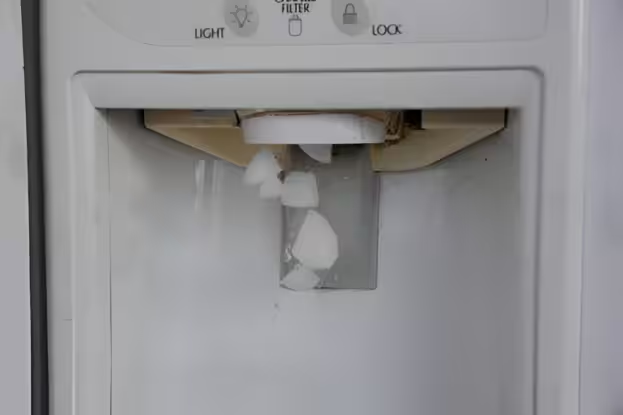
Signs of water inlet valve failure include: the ice maker makes no ice despite correct temperature and adequate water pressure, small hollow ice cubes indicating insufficient water reaching the molds, or a continuous dripping of water into the bin when the ice maker is turned off.
Mineral scale accumulation in the valve is common in areas with hard water. Mineral deposits progressively reduce the flow capacity of inlet valves and other water-using appliance components over time. Homes in Southern California frequently have moderately to significantly hard water, which accelerates this process.
Reason 5: Ice Maker Module or Control Board Failure
When the water supply, filter, temperature, and valve are all functioning correctly but the ice maker still does not produce ice, the issue is typically within the ice maker module itself or the control board that governs the ice-making cycle.
The ice maker module contains the motor that ejects cubes from the molds, the thermostat that triggers the harvest cycle, and the heater that slightly warms the molds to release formed cubes. Failure of any of these internal components will prevent ice from being ejected, even if it forms correctly in the molds.
Reason 6: Ice Bin Seating or Ice Jam
On many Sub-Zero and Viking models, the ice maker is only activated when the ice bin is correctly seated against a set of electronic contact points at the back of the freezer compartment. A bin that was replaced incorrectly after cleaning will prevent the ice maker from receiving the signal to operate, affecting ice makers function.
Ice jams can also halt production when water splashes onto ice already in the bin, freezes in place, and creates a solid mass that prevents newly ejected cubes from falling into the bin. This triggers the shut-off arm prematurely, and the ice maker reads the bin as full even when it is effectively empty.
Both of these issues are straightforward to identify and resolve. If you have recently accessed the ice bin for cleaning or found the bin repositioned after any service work, check seating first before scheduling a diagnostic call.
Conclusion
Whether the issue is a clogged filter, low water pressure, a faulty inlet valve, or a module failure, all of these problems are solvable. The right approach is a systematic diagnostic by a certified technician who can confirm the specific failure point and complete the repair with OEM parts in a single visit. For ice maker service on Sub-Zero, Viking, Monogram, or Thermador refrigerators across Santa Barbara and West Los Angeles, contact us. Same-day appointments available. Flat-rate pricing. Done right the first time.
FAQs:
The most common sudden causes are a frozen fill tube, a shut water supply valve, a full ice bin, or the ice maker being accidentally turned off.
After activation, allow 24 hours for the first batch of ice to form. The initial cycle takes longer as the system reaches operating temperature.
Sub-Zero recommends replacing the water filter every six months. Homes with hard water or high sediment levels may need more frequent replacement.
Yes. Sub-Zero requires between 20 and 120 psi. Below the minimum, water cannot fill the ice molds properly, resulting in no ice or small hollow cubes.
Small or hollow cubes almost always indicate insufficient water flow, pointing to low water pressure, a clogged filter, or a partially restricted inlet valve.
No. The ice maker operates as an independent system. The refrigerator can cool perfectly while the ice maker fails due to separate water supply or component issues.